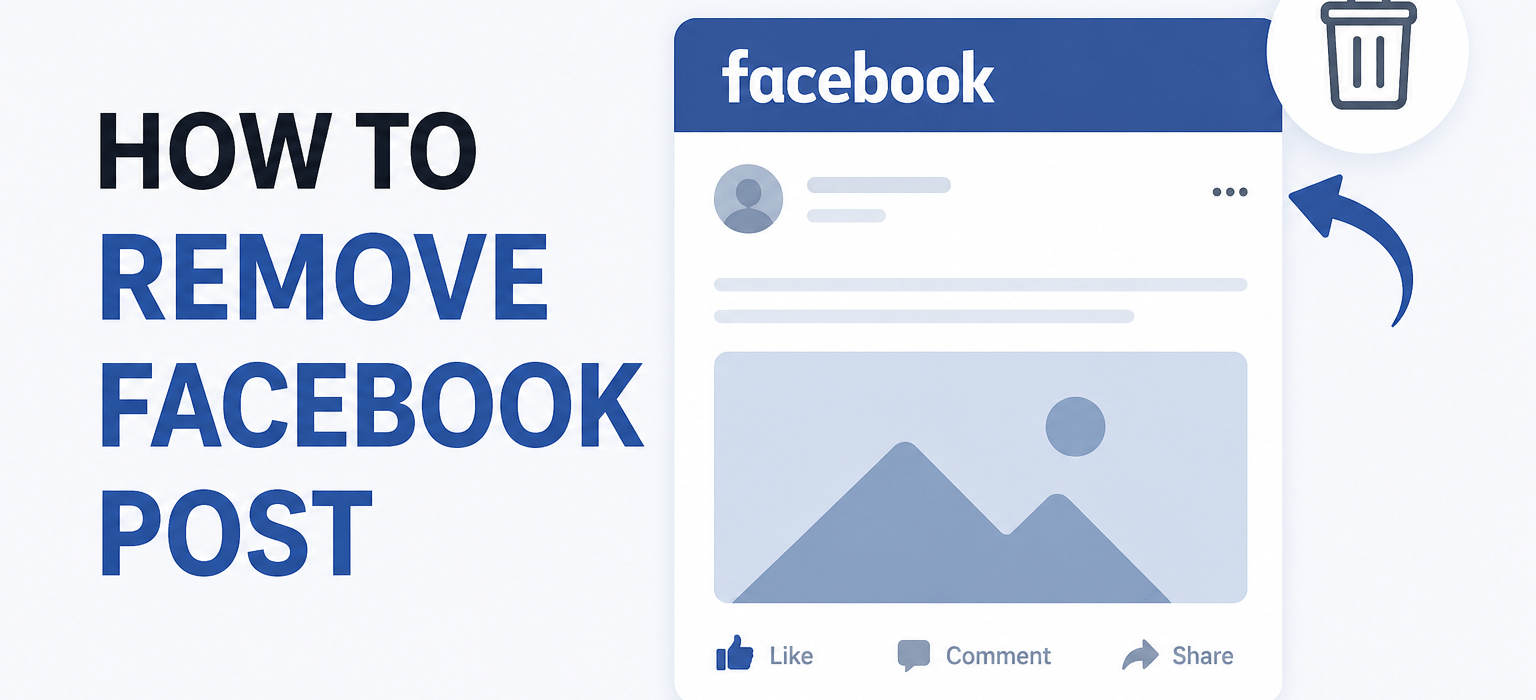
Searching for how to remove Facebook post content can lead to very different answers depending on who published the post.
If you published the post yourself, you can normally delete it, archive it or move it to your recycle bin. If someone else published the post, you cannot directly delete it from their account. Instead, you may need to contact the person, report the content to Facebook or use a specialised reporting process when your privacy or intellectual property rights are involved.
This guide explains how to remove your own Facebook posts and what you can do about harmful posts published by someone else.
How to Remove a Facebook Post: Quick Answer
The correct method depends on the situation:
- Your own post: Open the post, select the three-dot menu and choose the available delete or recycle-bin option.
- A post on your Facebook Page: Switch to the Page profile and remove the post using the post options or Page activity log.
- Someone else’s post: Ask the author to delete it or report it when you believe it violates Facebook’s rules.
- A post in which you are tagged: Remove the tag or hide the post from your profile. This does not necessarily delete the original post.
- A harmful or unauthorised post: Preserve the URL and screenshots before submitting the most relevant report.
Facebook’s Activity Log can be used to review and manage posts, photos, videos and other account activity. Depending on the content, Facebook may offer options to hide, delete, archive or move it to the recycle bin.
How to Delete a Facebook Post You Published
Removing your own Facebook post is usually the simplest situation.
Delete a Facebook Post From a Computer
- Sign in to Facebook.
- Open your profile.
- Find the post you want to remove.
- Select the three dots in the upper-right corner of the post.
- Choose Move to recycle bin, Delete post or the closest available option.
- Confirm your choice.
The wording may differ depending on the type of post, your location and the version of Facebook you are using.
Delete a Facebook Post From the Mobile App
- Open the Facebook app.
- Tap your profile picture.
- Find the post.
- Tap the three-dot menu.
- Select Move to recycle bin or Delete.
- Confirm the action.
Some content moved to the recycle bin remains there for up to 30 days before being automatically deleted. During that period, it may be possible to restore the post or delete it permanently.
How to Remove Multiple Facebook Posts
When you need to remove several old posts, using your Activity Log may be easier than opening each post individually.
Remove Posts Through Activity Log
- Open your Facebook profile.
- Select Settings & privacy.
- Open Activity Log.
- Find Your Facebook activity.
- Select your posts, photos or videos.
- Filter the results by date or activity type.
- Choose the content you want to manage.
- Delete, archive or move the selected posts to the recycle bin where those options are available.
Facebook notes that not every type of content can be moved to Archive or the recycle bin. The options shown depend on the content being managed.
Delete, Archive or Hide: What Is the Difference?
These options do not produce the same result.
Delete the Post
Deleting a post removes it from Facebook. Depending on how it was deleted, the content may first remain in the recycle bin before permanent deletion.
Archive the Post
Archiving makes eligible content visible only to you. It can generally be restored later with its previous audience settings.
Hide the Post From Your Profile
Hiding a post removes it from your profile, but it may remain visible elsewhere on Facebook, including Feed, Search or the profile of the person who originally published it.
This distinction is important. Hiding a Facebook post is not the same as deleting it.
How to Remove a Facebook Post Made by Someone Else
You cannot normally delete a Facebook post directly when it was published through another person’s account, Page or group.
However, you still have several options.
Option 1: Ask the Author to Remove It
When it is safe and appropriate, contact the person who published the post and explain why you want it removed.
Keep your message factual and calm. Clearly identify the post and explain the problem without making threats or starting a public argument.
This option may be suitable when:
- The post was published accidentally
- Outdated information was shared
- The person used your image without realising you objected
- Incorrect information can be resolved privately
- The author is willing to cooperate
Do not contact the person directly when doing so could place you at risk or intensify harassment.
Option 2: Report the Facebook Post
Facebook provides reporting options for posts, photos, comments and other content.
To report a post:
- Open the original Facebook post.
- Select the three dots near the post.
- Choose Find support or report post or the closest available option.
- Select the category that accurately describes the issue.
- Follow the instructions shown.
- Submit the report.
Facebook encourages users to report posts that they believe violate its Community Standards, particularly when contacting the publisher would be uncomfortable or unsafe.
Which Facebook Posts Can Be Reported?
A post should not be reported simply because it is negative, critical or embarrassing. The reporting reason should accurately match the content.
Depending on the facts, potentially relevant issues may include:
1 – Bullying or Harassment
Repeated personal attacks, degrading treatment, targeted harassment or abusive content may qualify for review.
2 – Threats or Violence
Posts containing credible threats, encouragement of violence or content creating a serious safety concern should be reported promptly. Contact local emergency services when there is an immediate danger.
3 – Hate Speech
Content attacking people based on protected characteristics may fall under Meta’s applicable standards.
4 – Impersonation
A profile or Page pretending to represent you, your business or another person may qualify for an impersonation report.
5- Privacy Violations
A post may raise privacy concerns when it exposes private information, sensitive documents, personal contact details or intimate content without permission.
6 – Copyright Infringement
A specialised intellectual property report may be appropriate when someone publishes your original photograph, video, design or other protected work without permission.
7 – Trademark Infringement
Businesses may have reporting options when a post improperly uses a protected brand name or logo in a way that infringes their rights.
8 – Scams or Fraud
Posts promoting deceptive offers, impersonation scams, fake competitions or fraudulent activity may qualify for reporting.
Facebook makes the final decision about whether reported content violates its rules. Meta’s Terms state that content violating its Community Standards may be removed and that review options may be available in certain circumstances.
How to Report a Facebook Post Effectively
Submitting repeated or unrelated reports is unlikely to strengthen a case. A clear and accurate report is more useful than selecting several categories that do not match the content.
Before reporting, collect:
- The direct Facebook post URL
- Full-page screenshots
- The name of the profile, Page or group
- The publication date
- Relevant comments or surrounding context
- Evidence showing why the statement is inaccurate
- Proof that you own the affected image, video or brand
- Previous communication with the publisher
- Any earlier report or reference number
Preserve the evidence before contacting the publisher because the content may be edited, restricted or deleted later.
What to Do When Facebook Does Not Remove the Post
A rejected report does not automatically mean that the post is true, lawful or acceptable. It only means Facebook did not remove it based on that particular review or reporting route.
Consider the following steps:
Review the Reporting Category
Check whether the selected reporting reason accurately matched the strongest issue in the post.
For example, copyright infringement, impersonation and privacy complaints may have different reporting routes from standard Community Standards reports.
Check Your Support Inbox
Facebook’s Support Inbox may contain the decision, status updates or an option to request another review.
Organise Better Evidence
A second submission should not simply repeat the first report. Add relevant context or documentation that was missing from the original request.
Use a Specialised Reporting Process
Some situations may require a dedicated process, such as:
- Copyright reporting
- Trademark reporting
- Impersonation reporting
- Privacy reporting
- Intimate-image reporting
- A legally valid removal request
Only use a legal or intellectual property form when the claim is genuine and you are authorised to submit it.
Obtain Professional Advice
When the post involves serious threats, defamation, private information or substantial commercial harm, consider obtaining advice from an appropriately qualified lawyer in the relevant country.
Can You Remove a Tag From Someone Else’s Facebook Post?
You may be able to remove a tag connecting the post to your profile.
Removing the tag may stop the post from appearing as tagged content on your profile, but it does not remove the original post from the publisher’s account.
If the original content is harmful, removing the tag should not replace reporting the post.
Can Blocking Someone Remove Their Facebook Post?
Blocking a person may limit interaction and what you can see, but it does not necessarily delete content they already published.
Preserve the post URL and screenshots before blocking the account if you may need to report the content later.
How to Remove a Post From a Facebook Page
A person with the appropriate Facebook or task access can delete posts published by a Page.
The usual process is:
- Switch from your personal profile to the Facebook Page.
- Open the post.
- Select the three-dot menu.
- Choose the delete option.
- Confirm the action.
Page administrators can also review Page activity through the Page’s Activity Log or Meta Business Suite, depending on their access level.
Common Mistakes to Avoid
Avoid these mistakes when trying to remove Facebook content:
- Reporting truthful criticism as impersonation
- Selecting a random reporting category
- Submitting fabricated evidence
- Making a false copyright claim
- Asking multiple people to mass-report the same post
- Threatening the publisher publicly
- Deleting your screenshots before the case is resolved
- Assuming that hiding a post removes it from Facebook
- Trusting anyone who guarantees removal
- Sharing your Facebook password with a removal provider
A legitimate removal service should assess the content, explain the relevant reporting options and be honest about the possibility of an unsuccessful outcome.
Frequently Asked Questions: Facebook Post Removal
You cannot normally delete a post directly from another person’s account. You can ask them to remove it or report it when there is a supportable policy or rights violation.
Review times vary according to the content, reporting method and circumstances. Facebook does not guarantee the same response time for every report.
Not every allegedly false statement violates Facebook’s rules. The content may need to fall under a specific policy, legal or rights-based reporting process.
No. Hiding a post from your profile may leave it visible in other areas of Facebook.
Content moved to the recycle bin may be restorable before the deletion period expires. Permanently deleted content generally cannot be restored through the normal account controls.
No. When another person published the post, Facebook or the original publisher makes the final decision. No legitimate service can guarantee that Facebook will remove every reported post.
Understanding how to remove a Facebook post is straightforward when you published it yourself. Cases involving content posted by another person can be more complicated.
Our Facebook Post Removal Service helps individuals and businesses:
- Assess potentially harmful Facebook posts
- Identify relevant platform policies
- Organise URLs, screenshots and supporting evidence
- Select the appropriate official reporting process
- Prepare clear and accurate reporting language
- Review available follow-up options
We do not hack accounts, manufacture evidence, organise false reports or guarantee removal. Facebook retains complete control over its platform and makes the final content decision.
Send us the Facebook post URL, screenshots and a short explanation to request a confidential assessment.