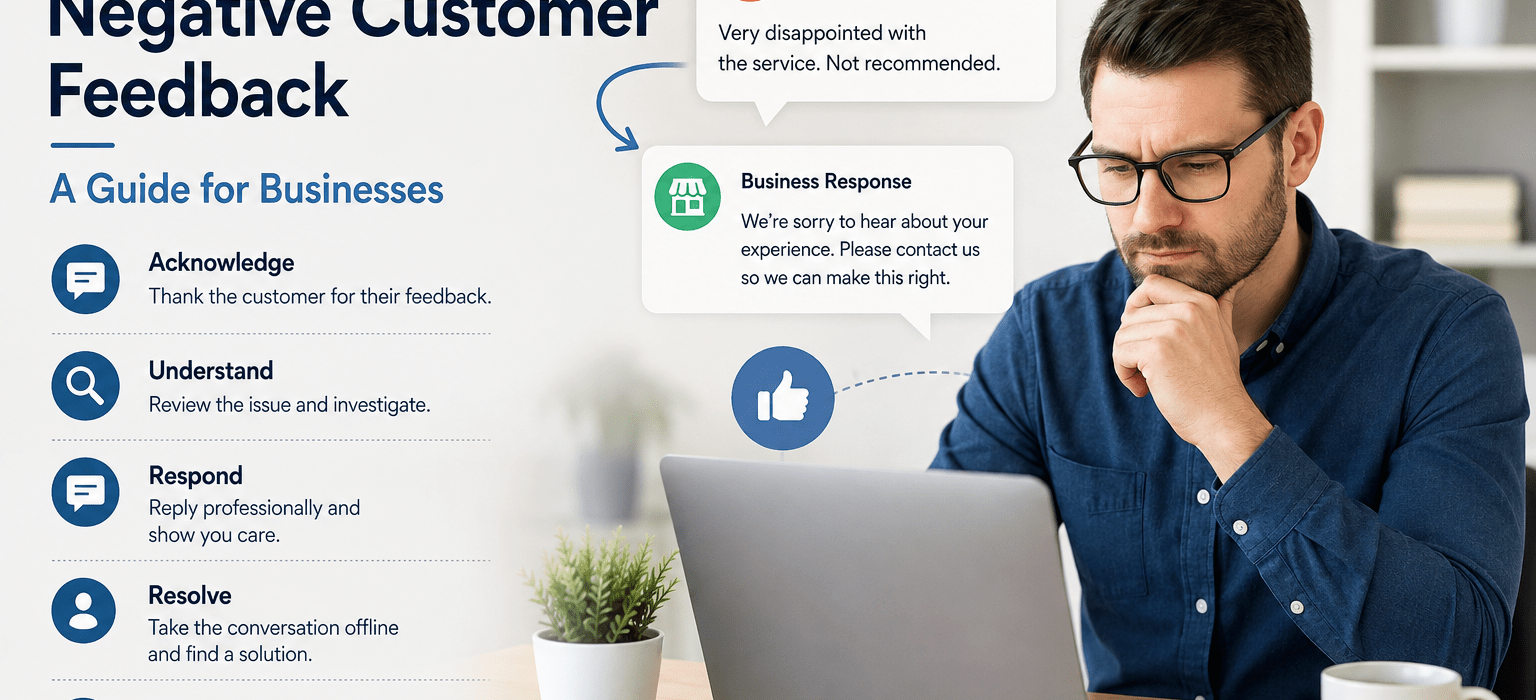
Negative customer feedback is part of doing business. Even companies with excellent products and customer service will occasionally receive complaints, low ratings, or critical comments online.
What matters is how your business responds.
A thoughtful response can demonstrate professionalism, show that your company listens to customers, and give you an opportunity to address misunderstandings or genuine service issues.
This guide explains how to respond to negative customer feedback professionally, what businesses should avoid doing, when to take a conversation offline, and how to handle suspicious or inappropriate online content.
What Is Negative Customer Feedback?
Negative customer feedback is any comment expressing dissatisfaction with a business, product, service, employee, transaction, or customer experience.
It may appear through:
- Google Business Profiles
- Social media
- Customer surveys
- Online directories
- Review platforms
- Support tickets
- Public forums
- Direct messages
Negative feedback does not always mean that your business has done something wrong. It may result from a genuine service problem, a misunderstanding, different expectations, or circumstances outside your control.
The first step is determining what actually happened.
Why Responding to Negative Customer Feedback Matters
When customers search for a business online, they may read both positive and negative experiences before making a decision.
A professional business response gives potential customers additional context.
Responding appropriately can help your company:
- Demonstrate good customer service
- Show that complaints are taken seriously
- Clarify misunderstandings
- Encourage customers to contact you privately
- Identify recurring operational problems
- Protect confidential information
- Maintain a professional online presence
The goal should not be to win an argument.
The goal is to show customers how your organization handles concerns.
Quick Guide: What to Do When You Receive Negative Feedback
| Situation | Recommended Action | What to Avoid |
|---|---|---|
| Genuine complaint | Acknowledge it and investigate | Becoming defensive |
| Service delay | Apologize for the inconvenience and provide next steps | Blaming the customer |
| Misunderstanding | Politely clarify the situation | Public arguments |
| Billing dispute | Move the discussion to a private channel | Publishing account information |
| Suspicious feedback | Document it and review platform policies | Immediately accusing the reviewer |
| Abusive content | Preserve evidence and check reporting options | Responding with insults |
| Privacy-related issue | Keep the response general and move offline | Disclosing personal information |
| Fake or unrelated content | Investigate and document available evidence | Offering incentives for deletion |
1. Read the Entire Complaint Before Responding
Do not respond based only on the star rating or first sentence.
Read the complete comment and identify the customer’s primary concern.
Ask:
- What is the customer complaining about?
- Is there a specific product or service mentioned?
- Can your business identify the transaction?
- Has the customer previously contacted your team?
- Is the complaint factually accurate?
- Has something been misunderstood?
- Can your business reasonably resolve the issue?
Gathering information before replying reduces the risk of posting an inaccurate or emotional response.
2. Investigate What Happened
If possible, check your internal records before responding publicly.
Depending on your business, you may want to review:
- Order information
- Appointment records
- Customer service notes
- Emails
- Support tickets
- Delivery records
- Billing history
- Previous communications
Only access information you are legally permitted to review.
Your investigation may confirm the complaint, reveal a misunderstanding, or show that your business cannot identify the experience described.
3. Respond Calmly and Professionally
Your response is public.
You are therefore speaking not only to the dissatisfied customer but also to every potential customer who may read the exchange later.
Avoid emotional responses.
Avoid responses such as:
You’re lying. This never happened.
or:
This is completely ridiculous and you have no idea what you’re talking about.
Even if you strongly disagree with the complaint, this type of response can create a larger reputation problem.
A more professional approach would be:
Thank you for bringing this to our attention. We take customer concerns seriously and would appreciate the opportunity to review what happened. Please contact our team directly so we can investigate further.
Professional does not mean admitting that every allegation is correct.
It means responding respectfully.
4. Acknowledge the Concern Without Automatically Admitting Fault
Businesses sometimes avoid responding because they believe saying “sorry” means accepting legal or financial responsibility.
You can acknowledge someone’s dissatisfaction without confirming allegations that you have not verified.
For example:
We’re sorry to hear that your experience did not meet your expectations.
This acknowledges the customer’s experience.
It does not necessarily confirm every factual allegation included in the complaint.
Another option is:
Thank you for sharing your concerns. We would like the opportunity to better understand what occurred and review the situation with our team.
5. Personalize Your Response
Copying exactly the same response underneath every negative comment can make your customer service appear automated.
Whenever possible, reference the issue without revealing confidential information.
Generic response
Sorry for your experience. Contact us.
Better response
We’re sorry to hear about the delay you experienced. Timely service is important to our team, and we would appreciate the opportunity to review what happened. Please contact us directly so we can investigate the situation.
The second response shows that someone actually read the customer’s concern.
6. Know When to Take the Conversation Offline
Some problems should not be discussed publicly.
Move the conversation to email, telephone, private messaging, or another secure customer-service channel when the issue involves:
- Personal information
- Medical information
- Appointment details
- Billing information
- Account information
- Financial transactions
- Employee disputes
- Contracts
- Sensitive customer records
- Complex complaints requiring investigation
You can respond publicly without revealing details.
For example:
We take your concern seriously. To protect your privacy, we cannot discuss individual account details publicly. Please contact our customer service team directly so we can review your case.
Types of Negative Feedback and How to Respond
| Type of Feedback | Best Response Strategy |
|---|---|
| Product complaint | Address the specific product concern and offer support |
| Customer service complaint | Acknowledge the experience and investigate internally |
| Long waiting time | Recognize the inconvenience and explain appropriate next steps |
| Price complaint | Clarify pricing where appropriate without arguing |
| Billing issue | Move the discussion to a private channel |
| Miscommunication | Politely clarify the information |
| Employee complaint | Avoid discussing personnel matters publicly |
| Privacy complaint | Respond generally and move immediately offline |
| Suspicious content | Document the content before taking action |
| Abusive content | Avoid engaging emotionally and review platform policies |
7. Do Not Argue Publicly With Customers
A lengthy argument underneath a negative comment rarely benefits the business.
Even when you have evidence supporting your position, consider whether that information should be published publicly.
A better approach is to:
- Acknowledge the concern.
- State that you would like to investigate.
- Invite the customer to contact your company privately.
- Continue the discussion outside the public platform.
If additional public clarification is necessary, keep it brief and factual.
8. Protect Customer Privacy
Never publish confidential information simply to prove that a customer is wrong.
For example, businesses should be extremely cautious about publicly discussing:
- Medical conditions
- Financial information
- Account numbers
- Addresses
- Telephone numbers
- Private correspondence
- Appointments
- Purchase history
- Internal customer records
Protecting customer privacy should take priority over winning an online disagreement.
9. Avoid Incentivizing Positive Feedback
Businesses should focus on gathering authentic customer feedback rather than attempting to control what customers say.
Avoid:
- Paying for positive comments
- Offering incentives specifically for positive ratings
- Asking employees to pretend to be customers
- Creating fake customer profiles
- Pressuring customers to change honest criticism
- Threatening customers over negative opinions
A strong online reputation should be built around genuine customer experiences.
10. Determine Whether the Feedback Is Genuine
Sometimes a business may receive feedback that it cannot immediately associate with a customer or transaction.
Do not immediately assume that the content is fake.
First investigate.
Look for information such as:
- Customer name
- Transaction date
- Product mentioned
- Appointment information
- Location
- Employee mentioned
- Order number
- Previous communication
- Details that correspond with your records
If the experience cannot be identified, document what you checked.
Genuine Criticism vs. Potential Policy Issue
It is important to distinguish between negative opinions and content that may violate a platform’s policies.
| Example | Usually Ordinary Feedback | May Require Policy Review |
|---|---|---|
| “I didn’t like the service.” | ✓ | |
| “The waiting time was too long.” | ✓ | |
| “I thought the price was expensive.” | ✓ | |
| Spam posted repeatedly | ✓ | |
| Review of the wrong business | ✓ | |
| Impersonation | ✓ | |
| Publication of sensitive personal information | ✓ | |
| Harassment or threats | ✓ | |
| Undisclosed conflict of interest | ✓ | |
| Content unrelated to an actual business interaction | ✓ |
A business should not seek to challenge feedback simply because it is negative.
Instead, determine whether there is a legitimate policy issue.
11. Document Suspicious or Inappropriate Content
If online content appears suspicious, save the relevant information before taking further action.
Useful documentation may include:
- Screenshot of the content
- Direct URL
- Reviewer or account name
- Date published
- Date discovered
- Relevant communications
- Supporting business records
- Previous reports
- Platform correspondence
Documentation makes it easier for your team to understand what happened and evaluate the available options.
12. Review the Platform’s Content Policies
Different platforms have different rules regarding user-generated content.
Before submitting a report, identify the specific rule that you believe the content violates.
Common policy categories may involve:
- Spam
- Fake engagement
- Harassment
- Impersonation
- Personal information
- Conflicts of interest
- Prohibited content
- Off-topic contributions
Avoid sending vague complaints such as:
This is unfair. Please delete it.
A policy-focused assessment is generally more useful because it identifies the specific issue requiring review.
13. Use Negative Feedback to Improve Your Business
Not every complaint is a reputation-management problem.
Sometimes feedback identifies something that genuinely needs improvement.
Look for patterns.
For example, if customers repeatedly complain about:
- Long telephone waiting times
- Slow delivery
- Appointment delays
- Difficult booking processes
- Poor communication
- Unexpected charges
- Product defects
the feedback may reveal an operational issue.
Fixing the underlying problem can be more valuable than focusing only on the public comments.
14. Create an Internal Feedback Response Process
Businesses receiving regular customer feedback should establish a simple internal process.
Example workflow
| Step | Action |
|---|---|
| 1 | Monitor new customer feedback |
| 2 | Determine whether a response is necessary |
| 3 | Investigate the customer’s concern |
| 4 | Draft a professional response |
| 5 | Check the response for confidential information |
| 6 | Publish the response |
| 7 | Move complex disputes to a private channel |
| 8 | Document serious or suspicious cases |
| 9 | Review recurring complaints |
| 10 | Improve internal processes where necessary |
Having a consistent process helps employees respond appropriately instead of reacting emotionally.
Examples of Responses to Negative Customer Feedback
Example 1: General Complaint
Thank you for sharing your feedback. We’re sorry your experience did not meet your expectations. We take customer concerns seriously and would appreciate the opportunity to learn more. Please contact our team directly so we can investigate.
Example 2: Waiting Time Complaint
Thank you for your feedback. We’re sorry about the delay you experienced. We understand how important your time is and would like to review what happened. Please contact our team so we can look into the situation.
Example 3: Complaint You Cannot Identify
Thank you for bringing this to our attention. We have been unable to identify the experience described based on the information available. We would appreciate it if you could contact our team directly with additional details so we can investigate.
Example 4: Confidential Matter
Thank you for contacting us. Because this matter may involve private account information, we are unable to discuss the details publicly. Please contact our team directly so we can review the situation securely.
Example 5: Misunderstanding
Thank you for your feedback. We believe there may have been a misunderstanding regarding this situation and would welcome the opportunity to clarify it. Please contact our team directly so we can assist you.
Should Businesses Respond to Every Negative Comment?
Not necessarily.
Some comments require a response, while others may be better handled through another channel.
Consider responding when:
- A customer has raised a legitimate service concern.
- Additional context may be useful.
- You can provide a constructive next step.
- The customer appears willing to resolve the problem.
Consider limiting engagement when:
- The conversation has become abusive.
- The same person repeatedly posts identical messages.
- Responding would require revealing confidential information.
- The issue has already been moved to an appropriate private channel.
Every situation should be evaluated individually.
What If Customer Feedback Appears to Violate Platform Policies?
Businesses sometimes encounter content that appears to involve spam, impersonation, harassment, conflicts of interest, privacy concerns, or other potential policy violations.
In these cases, the appropriate response may involve documenting the content and reviewing the reporting options provided by the platform.
At Remove Review, we help businesses evaluate online content against applicable platform policies, organize relevant supporting information, and understand available reporting and escalation options.
Platforms make their own moderation decisions, and removal cannot be guaranteed.
This policy-focused approach helps businesses address problematic online content without attempting to manipulate legitimate customer feedback.
How to Build a Better Online Reputation
Responding to complaints is only one part of reputation management.
Businesses can strengthen their online reputation by:
- Providing consistent customer service
- Making contact information easy to find
- Responding quickly to legitimate complaints
- Training employees on customer communication
- Monitoring major online platforms
- Encouraging authentic customer feedback
- Correcting recurring operational problems
- Maintaining accurate business information online
- Having a documented escalation process
- Understanding platform content policies
A strong reputation is built over time through consistent customer experiences and professional communication.
Frequently Asked Questions
Yes. Recurring complaints can help identify weaknesses in customer service, communication, billing, delivery, scheduling, or other operational areas.
First investigate whether the experience can be identified. If there is evidence suggesting the content may violate platform policies, document the situation and use the appropriate reporting process.
Avoid repeating the information publicly. Preserve appropriate evidence and review the platform’s privacy or personal-information reporting options.
Platforms generally provide reporting mechanisms for content that may violate their rules. Businesses should review the relevant platform policies and identify the specific potential violation before submitting a report.
Review your records using the information available. If you cannot identify the experience, politely invite the person to contact your business with additional details.
A brief public response can be appropriate. Sensitive details should usually be discussed privately through a secure communication channel.
You can acknowledge that someone had a disappointing experience without necessarily admitting every allegation. Statements such as “We’re sorry your experience did not meet your expectations” can show empathy while allowing the business to investigate.
A business should remain professional, acknowledge the customer’s concern, investigate what happened, avoid arguments, protect confidential information, and provide a clear next step where appropriate.
Final Thoughts
Negative customer feedback does not automatically mean that your business has a reputation crisis.
A professional response can show customers that your organization listens, investigates concerns, protects privacy, and takes customer service seriously.
The best approach is straightforward:
Listen. Investigate. Respond professionally. Protect privacy. Learn from genuine criticism. Review suspicious content against the applicable platform policies.
When online content raises potential policy concerns, businesses should focus on evidence and the platform’s established reporting procedures rather than attempting to manipulate legitimate customer feedback.