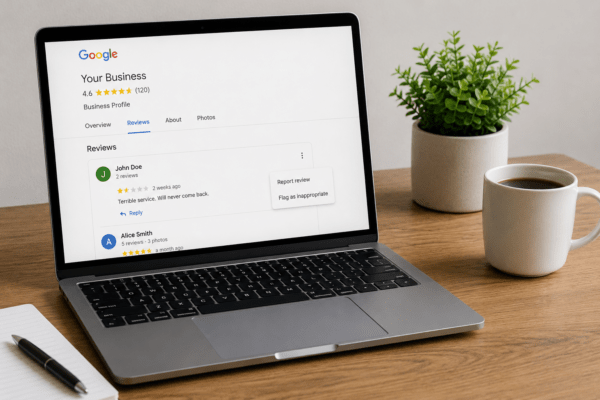
If you discover that a competitor has left a negative review on your Google Business Profile, you may have grounds to request its removal.
Google does not remove a review simply because it is negative. However, reviews involving conflicts of interest, fake engagement, rating manipulation, or attempts by competitors to damage another business’s reputation may violate Google Maps policies.
This distinction is important.
A genuine customer who had a poor experience is generally allowed to leave a negative review. A competitor using Google Reviews to harm your reputation may be a very different situation.
Are Competitor Reviews Against Google’s Policies?
They can be.
Google states that contributions to Google Maps should represent genuine experiences and should be genuine and unbiased.
Google’s policy specifically prohibits users from posting content on a competitor’s business with the purpose of undermining that business or product’s reputation.
Google also considers certain relationships a potential conflict of interest, including professional affiliations and industry competitors.
Therefore, if a competitor leaves a review intended to manipulate your rating or damage your reputation, there may be valid grounds for reporting the review.
What Is a Conflict of Interest Review?
A conflict of interest occurs when the reviewer has a relationship or interest that could prevent the review from being genuinely impartial.
Examples may include:
- A competing business owner reviewing your company negatively.
- An employee of a competitor leaving a one-star review.
- A former employee reviewing their previous employer.
- Someone professionally connected to a competing company reviewing your business.
- Multiple people connected to a competitor targeting the same business.
- A business owner reviewing competing businesses to improve their own competitive position.
Google’s current Maps policy says conflicts of interest may include current or former employment, contractual or consulting relationships, professional affiliations, personal relationships and industry competitors.
However, simply believing that a reviewer works for a competitor is normally not enough.
You should provide as much evidence as possible.
What Evidence Can Help Prove the Reviewer Is a Competitor?
Evidence can make a significant difference when challenging a suspected competitor review.
Useful evidence may include:
1. The Reviewer’s Employment Information
If the reviewer publicly identifies themselves as an employee, owner or manager of a competing business, take screenshots.
Possible sources include:
- LinkedIn profiles
- Company websites
- Business directories
- Professional profiles
- Social media accounts
The goal is to establish a clear connection between the reviewer and the competing business.
2. Their Google Maps Review History
Look at the reviewer’s public Google Maps profile.
A suspicious pattern might include reviewing several competing businesses negatively while reviewing one particular competitor positively.
Google says unusual patterns of review activity that indicate attempts to manipulate ratings can fall under its rating-manipulation policy.
One suspicious review alone does not automatically prove manipulation, but a broader pattern may provide useful context.
3. Business Ownership Records
If the reviewer owns or manages another company in your industry, public company records or the competitor’s own website may help establish that relationship.
4. Messages or Communications
If the reviewer has contacted your company and admitted that they represent a competitor—or threatened to damage your reputation—keep copies of those communications.
Do not alter the screenshots.
Preserve the original dates, usernames and context whenever possible.
5. Evidence That No Genuine Customer Relationship Exists
Check your:
- CRM
- Appointment records
- Customer database
- invoices
- email records
- booking system
If there is no record of the reviewer, this information can support your case.
However, the fact that you cannot find someone in your customer database does not automatically prove that a review is fake. Reviews should be evaluated based on the complete circumstances and Google’s policies.
Example of a Competitor Review That May Violate Policy
Imagine two roofing companies operating in the same city.
The owner of Company A leaves this review on Company B:
“Terrible company. Avoid them and use another local roofing company instead.”
You investigate the reviewer and discover that they publicly identify themselves as the owner of Company A.
The review may present a clear conflict-of-interest concern because the reviewer has a direct commercial interest in the reputation of Company B.
That is very different from an ordinary customer leaving a one-star review after receiving poor service.
What If the Competitor Actually Used My Business?
This situation becomes more complicated.
A person connected to a competitor could theoretically also have a genuine experience with your company.
The existence of a professional relationship does not mean every review will automatically be removed.
Google evaluates whether content violates its policies.
The strongest cases typically involve evidence showing that the review is biased, manipulative, not based on a genuine experience, or intended to undermine a competing business.
How to Report a Competitor Review to Google
If you believe the review violates Google’s policies:
Step 1: Document Everything
Before reporting the review, save:
- A screenshot of the review
- Reviewer name
- Reviewer profile
- Review date
- Review URL if available
- Evidence connecting the reviewer to the competitor
- Relevant business records
- Any messages or communications
Do this before taking further action because reviews and profiles can change.
Step 2: Report the Review
Business owners can report reviews through their Google Business Profile or Google’s review-management process.
Select the reason that most accurately reflects the situation.
Do not select random policy categories simply because you want the review removed.
Google says that only reviews violating its policies are eligible for removal; disagreement with a negative review alone is not sufficient.
Step 3: Explain the Conflict Clearly
If you have an opportunity to provide additional information, keep the explanation concise.
For example:
“The reviewer is the owner/employee of a competing business operating in the same industry and market. We believe this review represents a conflict of interest and was posted to negatively affect our business’s reputation. Supporting evidence demonstrating the reviewer’s affiliation with the competing company is available.”
Focus on the policy issue rather than arguing about whether the review is unfair.
Step 4: Appeal When Appropriate
If Google initially decides that the review does not violate its policies, additional review or appeal options may be available depending on the case.
Provide clear evidence rather than repeatedly submitting identical reports.
Should You Reply to a Suspected Competitor Review?
Sometimes.
A professional public response can protect your reputation while the review is being investigated.
For example:
“We take customer feedback seriously, but we have been unable to identify a customer interaction matching the information in this review. We would be happy to investigate further if the reviewer contacts us directly.”
Avoid publicly accusing the reviewer of being a competitor unless you have strong evidence.
An aggressive response can create a second reputation problem even if the original review is eventually removed.
Can Google Remove the Reviewer’s Entire Account?
Google allows users to report profiles that appear to engage in policy-violating behavior.
Google states that profiles involved in false information, misleading behavior or other violations may be reviewed, and users who violate its policies may face feature restrictions.
This can be relevant when one account appears to be targeting multiple businesses rather than posting one isolated questionable review.
What About Multiple Fake Reviews From a Competitor?
Multiple coordinated reviews can create a stronger indication of manipulation.
For example, you might notice:
- Several one-star reviews appearing within hours.
- Reviewers connected to the same competitor.
- Similar wording across different accounts.
- New profiles created primarily to review your company.
- The same accounts attacking multiple competitors.
- Positive reviews being posted to one business while competitors receive negative reviews.
Google says it uses automated systems as well as human review to identify suspicious and policy-violating Maps contributions.
Document the overall pattern instead of treating every review as an unrelated incident.
Can a Competitor Review Be Removed Just Because the Reviewer Is a Competitor?
Not automatically.
The key issue is whether the review violates Google’s policies.
Google does not promise removal simply because a business reports a review.
But when there is credible evidence that a competitor, employee of a competitor or professionally connected individual is using reviews to manipulate ratings or undermine another business, the review may fall within Google’s policies concerning fake engagement, rating manipulation or conflicts of interest.
What If Google Refuses to Remove the Review?
A rejected report does not necessarily mean there are no further options.
The next step depends on the circumstances.
You may need to:
- Review the exact Google policy involved.
- Collect stronger evidence.
- Identify connections between the reviewer and competitor.
- Examine the reviewer’s contribution history.
- Document coordinated review activity.
- Use an available appeal process.
- Consider other applicable reporting channels when the content raises separate legal issues.
Repeatedly reporting the same review without providing additional evidence is unlikely to strengthen the case.
A properly documented policy argument is much more useful.
Need Help Reviewing a Suspected Competitor Review?
If you believe a competitor, former employee, industry contact or connected individual has posted a review against your business, Remove Review can assess the content and circumstances before you decide what to do next.
We analyze reviews against relevant platform policies and help identify the strongest available reporting approach.
Send us the review for a confidential assessment.
There is no guarantee that Google will remove a review. Removal decisions are ultimately made by Google based on its policies and review process.
Frequently Asked Questions
Can a business owner leave a review on a competitor’s Google profile?
A review involving an industry competitor may create a conflict-of-interest issue under Google’s Maps policies, particularly when the content is intended to manipulate ratings or undermine the competing business.
Can an employee of a competitor leave me a bad Google review?
If the employee’s professional relationship creates a conflict of interest or the review is not based on a genuine experience, it may potentially violate Google’s policies.
Will Google remove a review if the person was never my customer?
Not necessarily. Being unable to locate the reviewer in your records does not by itself guarantee removal. Other evidence showing fake engagement, manipulation or a conflict of interest can strengthen the report.
What proof should I send Google?
Useful evidence can include public employment information, business ownership records, screenshots, reviewer contribution history, communications and other documentation showing the connection between the reviewer and a competing business.
Can competitors be reported for fake Google reviews?
Yes. Reviews that violate Google’s fake-engagement, rating-manipulation or conflict-of-interest policies can be reported. Google determines whether the content qualifies for removal.
How long does competitor review removal take?
There is no guaranteed removal timeframe. The review process varies depending on the circumstances, evidence, reporting route and whether additional review or an appeal is required.
Last updated: August 2026
Disclaimer: Remove Review is an independent service and is not affiliated with Google. Google controls its own content moderation and removal decisions. Reporting a review does not guarantee that it will be removed.