A strong Google rating can make a huge difference for a business. More positive reviews can improve customer confidence, increase calls and website visits, and help your business stand out when people compare local companies.
Because of this, some businesses are tempted to take a shortcut and buy Google reviews.
It may seem simple: pay someone, receive several 5-star reviews, increase your rating, and attract more customers.
Unfortunately, that shortcut can create much bigger problems than the negative reviews you were trying to overcome.
Buying Google reviews violates Google’s policies, can result in reviews being removed, may lead to restrictions on your Google Business Profile, and can seriously damage the trust customers have in your business.
Here is why buying Google reviews is rarely worth the risk.
What Does It Mean to Buy Google Reviews?
Buying Google reviews generally means paying a person, agency, website, or network to publish reviews on your Google Business Profile.
These reviews may come from:
- People who have never used your business
- Accounts created specifically for posting reviews
- Large networks of reviewers
- Employees, friends, or other people with a conflict of interest
- Automated or artificially controlled accounts
Some providers advertise packages such as:
| Package | Typical Promise |
|---|---|
| 5 Google Reviews | Quick rating improvement |
| 10 Google Reviews | Multiple 5-star reviews |
| 25+ Google Reviews | Large reputation boost |
| Monthly Reviews | New reviews added gradually |
The problem is simple: if the reviewer did not have a genuine experience with your business, the review may violate Google’s policies.
1. Buying Google Reviews Violates Google’s Policies
Google’s review policies require reviews to reflect a genuine experience with a business.
Google specifically prohibits reviews or ratings that have been paid for, directly or indirectly.
Google also prohibits businesses from offering incentives such as payments, discounts, free products, or free services in exchange for reviews.
This means that purchasing a package of positive reviews is not an approved reputation-management strategy.
Even if the reviews initially appear on your profile, that does not mean they will remain there.
Google may identify and remove them later.
2. Google Can Remove the Reviews You Paid For
One of the biggest problems with buying reviews is that you are paying for something you do not control.
A provider might promise:
“Permanent Google reviews.”
In reality, nobody outside Google can guarantee that a review will remain published permanently.
Google continuously evaluates reviews for signals associated with fake engagement and rating manipulation.
Suspicious activity can include unusual review patterns, reviews from accounts with questionable activity, coordinated posting, or other signals indicating the reviews may not represent genuine customer experiences.
This can leave you in an unfortunate situation:
You pay for the reviews → your rating increases → Google detects the activity → the reviews disappear.
You may end up exactly where you started, except you have also lost the money you spent purchasing the reviews.
3. Your Google Business Profile Can Be Restricted
The consequences can go beyond simply losing the fake reviews.
Google states that businesses violating its fake-engagement policies may face restrictions on their Business Profiles.
Depending on the circumstances, Google may:
- Prevent the profile from receiving new reviews for a period of time
- Temporarily unpublish existing reviews or ratings
- Remove reviews considered to violate its policies
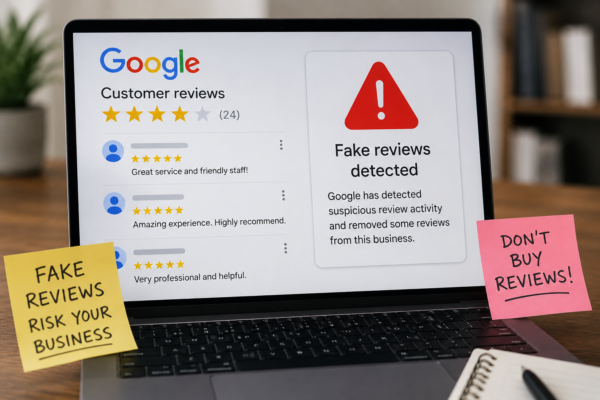
- Display a warning indicating that suspicious or fake reviews were removed
Imagine a potential customer researching your company and seeing a warning suggesting that fake reviews were removed.
The short-term benefit of purchasing a few 5-star reviews could turn into a serious reputation problem.
4. Fake Reviews Can Make Your Profile Look Less Trustworthy
Customers are becoming increasingly good at recognizing suspicious reviews.
Consider these two examples.
Example A: Natural Review
“I visited the clinic on Tuesday morning. The receptionist was helpful and Dr. Smith explained the treatment options clearly. I waited around 15 minutes, but overall I had a good experience.”
Example B: Suspicious Review
“Amazing company!!! Best service ever!!! Highly recommended to everyone!!!”
The second review is not necessarily fake, but when a profile suddenly receives many similar generic reviews, potential customers may become suspicious.
Authentic customer reviews usually contain natural variations.
Some are short.
Some are detailed.
Some give five stars.
Others give four stars while mentioning something the business could improve.
That variation actually makes a business look more credible.
A profile containing nothing except perfect, generic 5-star reviews can sometimes create the opposite impression.
5. Buying Reviews Can Damage Your Reputation
Trust is one of the main reasons reviews matter.
Customers read reviews because they want opinions from people who have actually dealt with your business.
If customers discover that reviews have been purchased, the damage can extend beyond your Google rating.
They may begin questioning:
- Whether your reputation is genuine
- Whether your testimonials are authentic
- Whether other marketing claims can be trusted
- Whether they should choose a competitor instead
Building a strong reputation can take years.
Losing customer trust can happen much faster.
6. Buying Fake Reviews Can Create Legal Problems
Depending on where your business operates, fake reviews can also create regulatory risks.
For example, in the United States, the Federal Trade Commission’s Consumer Reviews and Testimonials Rule addresses deceptive review practices.
The rule prohibits certain practices involving fake or false consumer reviews and prohibits businesses from buying reviews where compensation or incentives are conditioned on the review expressing a particular sentiment.
Businesses should therefore think about more than just Google’s policies.
Fake-review practices can potentially become a consumer-protection issue as well.
Businesses operating outside the United States should also check their applicable advertising and consumer-protection laws.
7. Purchased Reviews Often Come From Low-Quality Accounts
Another issue is that you usually have very little control over where purchased reviews come from.
A review seller may use accounts that:
- Review businesses in several unrelated countries
- Post dozens of reviews within short periods
- Have little or no genuine Google activity
- Repeatedly leave similar 5-star reviews
- Have never been near the location they are reviewing
Even if the review text looks convincing, the account behind it may create obvious credibility problems.
Google has access to considerably more information about account and review activity than what businesses can see publicly.
Simply making a review “look real” does not necessarily make it authentic.
8. Fake Reviews Don’t Fix the Real Reputation Problem
Suppose your business has:
- 100 reviews
- A 3.7-star rating
- Several unhappy customers complaining about slow service
Buying twenty 5-star reviews may temporarily improve the visible rating.
But customers will still experience slow service.
Eventually, new negative reviews may appear.
The actual problem was never the rating.
The problem was the experience producing the negative reviews.
A stronger strategy would be:
Identify the complaint → fix the underlying problem → respond professionally → encourage genuine customers to share their experiences.
That creates a reputation improvement that can continue over time.
9. A Sudden Increase in Reviews Can Look Suspicious
Imagine a business normally receives three to five reviews every month.
Then suddenly:
20 five-star reviews appear within three days.
Even an ordinary customer might notice something unusual.
Authentic review growth generally follows real customer activity.
Businesses should therefore focus on creating a consistent process for requesting genuine feedback rather than trying to artificially increase review numbers overnight.
Bought Google Reviews vs Genuine Google Reviews
| Bought Reviews | Genuine Reviews |
|---|---|
| Reviewer may never have used the business | Based on a real experience |
| Violates Google’s fake-engagement rules | Allowed by Google |
| May be removed | More likely to remain |
| Can create profile restrictions | Builds long-term credibility |
| Often generic | Usually reflects real details |
| Creates reputation risk | Builds customer trust |
| Costs money for artificial engagement | Can be requested from customers legitimately |
The safer strategy is clear.
Build genuine reviews instead of purchasing them.
What Should You Do Instead of Buying Google Reviews?
There are several legitimate ways to strengthen your Google reputation.
Ask Real Customers for Reviews
Google allows businesses to ask customers who genuinely used their products or services to leave reviews.
You can create a direct Google review link or QR code and share it through:
- SMS
- Receipts
- Appointment follow-ups
- Your website
- Printed materials
The request should remain neutral.
Instead of saying:
“Please leave us a 5-star review.”
Use something like:
“Thank you for choosing our business. We would appreciate hearing about your experience on Google.”
Let the customer decide what rating to leave.
Respond to Negative Reviews
A professional response can sometimes be nearly as important as the review itself.
Potential customers understand that no business is perfect.
What matters is how the business responds when something goes wrong.
A useful response can:
- Acknowledge the customer’s concern.
- Avoid arguing publicly.
- Clarify factual misunderstandings when appropriate.
- Invite the customer to contact the business privately.
- Explain what you are doing to resolve the issue.
Future customers reading the conversation may judge your response just as much as the original complaint.
Improve the Customer Experience
Look for patterns in your negative feedback.
If multiple people mention:
- Long wait times
- Communication problems
- Billing confusion
- Unanswered calls
- Poor customer service
those reviews may be telling you exactly where improvements are needed.
Fixing those issues can naturally produce better reviews in the future.
Report Reviews That Violate Google’s Policies
Not every negative review should be removed.
A genuine customer is allowed to describe a legitimate negative experience.
However, some reviews may violate Google’s policies.
Examples can include certain forms of:
- Fake engagement
- Spam
- Harassment
- Impersonation
- Conflicts of interest
- Off-topic content
- Prohibited or misleading content
If you believe a review violates Google’s rules, you can report it through Google’s available reporting processes.
Removing a legitimate negative review is never guaranteed simply because the review hurts your rating. The review generally needs to violate an applicable platform policy.
Can You Pay Customers to Leave Google Reviews?
Paying customers or offering discounts, gifts, or free products in exchange for reviews can violate Google’s policies.
The safer approach is to request genuine feedback without offering an incentive tied to leaving, changing, or removing a review.
Google allows businesses to encourage customers with genuine experiences to leave reviews as long as the business does not attempt to manipulate the rating or content.
Can You Ask Only Happy Customers for Google Reviews?
This is another practice businesses should avoid.
Google’s policies prohibit businesses from selectively soliciting positive reviews while discouraging negative feedback.
Instead, businesses should create a consistent process that gives customers a fair opportunity to share their experience.
What If You Already Bought Google Reviews?
If you previously purchased reviews, the worst solution is usually to keep buying additional reviews to maintain an artificially inflated rating.
Instead, start building a legitimate review strategy.
Focus on:
- Genuine customer feedback
- Better customer service
- Professional responses
- Monitoring your Google Business Profile
- Reporting reviews that legitimately violate Google’s policies
The goal should be to gradually build a reputation that reflects real customer experiences.
Frequently Asked Questions
Is buying Google reviews allowed?
No. Google’s policies prohibit paid reviews and other forms of fake engagement that do not represent genuine experiences.
Can Google detect bought reviews?
Google uses systems and signals to identify suspicious review activity and policy violations. Businesses should not assume that a review is safe simply because it was successfully published.
Can Google remove purchased reviews?
Yes. Reviews that violate Google’s policies may be removed.
Can buying reviews affect my Google Business Profile?
Yes. Google says profiles involved in fake-engagement violations may face restrictions in addition to having reviews removed.
Is it okay to offer customers a discount for a Google review?
Google prohibits incentives such as payments, discounts, free products, or free services in exchange for posting, changing, or removing reviews.
Is asking customers for Google reviews allowed?
Yes. Google allows businesses to encourage customers who genuinely used the business to share their experiences, provided the business does not offer prohibited incentives or attempt to influence the rating or content.
What should I do about fake negative Google reviews?
If you believe a negative review violates Google’s policies, document the issue and report the review through Google’s reporting process. A negative rating alone is not normally sufficient reason for removal.
Final Thoughts: Don’t Buy Google Reviews—Build a Reputation That Lasts
Buying Google reviews can look like an easy solution when your business needs more positive feedback.
But the potential short-term increase in your rating is rarely worth the risks.
Purchased reviews can disappear. Your Google Business Profile can face restrictions. Customers can lose trust in your company. And depending on your jurisdiction, deceptive review practices can potentially create legal or regulatory problems.
There is a better approach.
Encourage genuine customers to share their experiences, respond professionally to criticism, improve the problems mentioned in negative feedback, and report reviews that genuinely violate Google’s policies.
A reputation built from real customer experiences takes more work.
But it is also much harder to lose.
Need help dealing with suspicious or policy-violating Google reviews?
Remove Review helps businesses analyze reviews against platform policies and identify legitimate options for reporting problematic content. Review removal is never guaranteed, but when content violates Google’s policies, the appropriate evidence and reporting process can make a significant difference.